Clear Legal & Insurance Standing
Possess formal, signed documentation that clearly defines liability, risk levels, and structural tree failure factors.
Independent, AQF Level 5 consulting arborist reports, structural risk assessments, and tree health documentation in Moil.
Providing consulting arborist reports across Moil, Jingili, Alawa, and Darwin.
Our arborist report Moil service delivers detailed written assessments for property owners, insurers, and commercial developers.
While City of Darwin does not mandate private tree removal permits, formal arborist reports are frequently needed in Moil for insurance dispute settlements, building certifier requirements near foundations, and commercial project approvals under the NT Planning Scheme.
Possess formal, signed documentation that clearly defines liability, risk levels, and structural tree failure factors.
Design home additions, swimming pools, or carports accurately around calculated Tree Protection Zones.
Receive actionable, prioritised recommendations for pruning, cabling, or removal based on quantified risk.
Our AQF Level 5 arborist visits your Moil property to inspect canopy health, trunk integrity, root flare, and site conditions.
We record measurements, identify fungal or termite decay, evaluate defect severity, and calculate root protection zones.
We prepare a structured written report complete with high-resolution photography, risk matrices, and recommendations.
You receive the finalised PDF report, followed by a consultation to discuss the findings and practical next steps.
If you are managing trees on residential, commercial, or development sites, securing a comprehensive Arborist Report Moil is your definitive first step for managing risk and site planning.
Darwin's monsoon tropics present extreme environmental challenges for urban trees. The devastation of Severe Tropical Cyclone Fina in November 2025, which impacted around 19,000 properties, alongside the historic damage of Cyclone Marcus, exposed just how vulnerable our local canopy is when saturated ground and high winds combine. In Moil and surrounding Darwin suburbs, shallow lateritic hardpans severely restrict root depth. This geological feature leads to compromised root plates and balled root systems that remain hidden until the wet season arrives.
Whether you need to assess a towering African Mahogany overhanging your roof, establish tree protection zones for a new residential build, or document storm damage for an insurance claim, our team provides the documented, scientific evidence you need. We bring AQF Level 5 consulting expertise to every site, ensuring your property is prepared, safe, and fully informed by the realities of the Top End climate.
When a severe weather event approaches Darwin, guesswork is not a viable strategy. Relying on an under-qualified tree lopper or attempting a DIY visual assessment can lead to catastrophic property damage or unnecessary tree removal. Many property owners incorrectly assume a tree is structurally sound simply because the canopy looks green and vigorous. However, subsequent storm reviews in the Territory have repeatedly proven that seemingly healthy trees—especially fast-growing species planted in poor, compacted soils—often hide critical structural defects. Darwin sits on a notoriously gravelly, sandy surface over poorly structured clay, creating a lateritic hardpan that forces root systems to spread shallowly. Without an AQF Level 5 consulting arborist, you risk misidentifying hazard trees that are vulnerable to windthrow, violating your duty-of-care obligations, or breaching site development conditions. Poorly documented tree protection plans routinely result in construction damage to structural root zones, causing mature trees to slowly decline and become dangerous liabilities years later. Our team solves this by providing rigorous, scientifically backed arboricultural reporting. We conduct detailed Visual Tree Assessments (VTA) to identify structural flaws, decay, and root constraints long before they fail. By engaging our experts, Moil property owners receive clear, actionable data that balances the retention of resilient species like Banyan and Northern Milkwood with the necessary mitigation of high-risk hazards.
Our AQF Level 5 consulting arborists deliver detailed, standard-compliant reports tailored to the unique environmental and regulatory conditions of the Top End. We utilise advanced diagnostics to provide actionable insights for your property.
We produce comprehensive AS4970-2009 compliant reports for construction sites. This includes accurately calculating and mapping Tree Protection Zones (TPZ) and Structural Root Zones (SRZ) based on trunk diameter, ensuring retained trees survive excavation and site works.
Using industry-standard Visual Tree Assessment methodologies, we document structural defects, evaluate target zones, and calculate the likelihood of failure. This is essential for pre-purchase inspections, strata compliance, and cyclone preparedness.
Following extreme storm events, our team provides independent damage assessments and causation analysis. We document the mechanical failure points—such as lateritic soil failure or decayed root plates from overwatering—for insurance claims and legal documentation.
We evaluate the health, structure, and species-specific traits of your trees to assign SULE ratings. This helps property managers in Moil forecast maintenance budgets and plan for phased canopy replacement using cyclone-resilient local species.
Delivering an accurate, legally robust tree assessment requires a methodical approach. When you engage our team for an Arborist Report Moil, we follow a strict process from the initial consultation to the final PDF delivery.
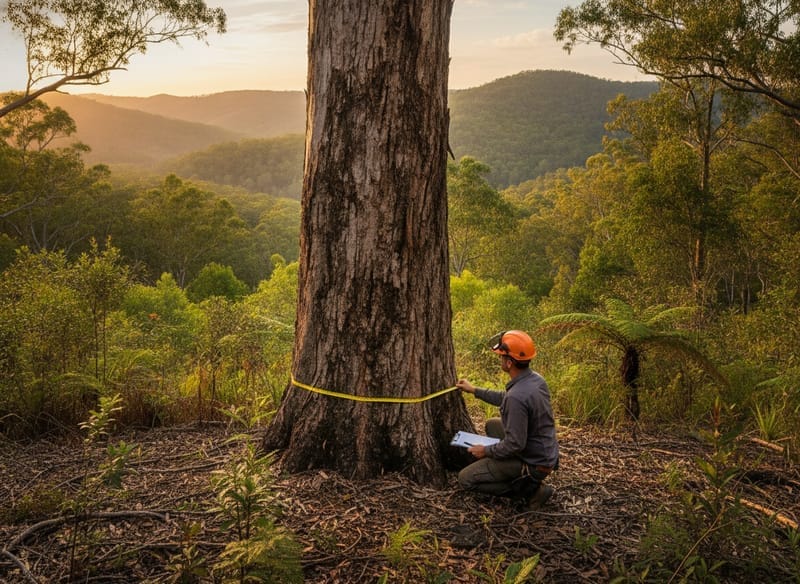
First, we discuss your specific requirements—whether you are dealing with a boundary dispute, planning a property extension, or assessing post-cyclone tree stability. We then schedule a comprehensive site visit. Our consulting arborist arrives on-site to conduct hands-on data collection. We measure the Diameter at Breast Height (DBH), map the canopy spread, evaluate the soil profile, and conduct a detailed Visual Tree Assessment (VTA) to identify pathogens, structural weaknesses, or past lopping damage.
Once the field data is secured, we draft the formal report. This includes cross-referencing our findings against local terrain factors, calculating the necessary AS4970 protection zones, and compiling photographic evidence. Finally, we deliver a comprehensive PDF document directly to your inbox. This finalised report includes clear recommendations, risk mitigation strategies, and any required specifications for our AQF Level 3 climbing arborists to execute when you are ready to proceed with the physical tree work.
Every report our team produces is grounded in authoritative Australian Standards. We strictly apply AS4970 Protection of Trees on Development Sites for all construction-related assessments, and base our maintenance recommendations on AS4373 Pruning of Amenity Trees. This ensures any prescribed pruning, such as selective crown thinning or deadwooding, is structurally sound and never resorts to harmful topping practices.
Our consulting arborists hold AQF Level 5 Diplomas of Arboriculture, the mandatory qualification for formal reporting. Furthermore, our business is fully insured with comprehensive public liability and professional indemnity cover. When we document a hazard or certify a tree protection plan, builders, insurers, and property managers in Darwin can completely trust the technical authority of our findings.
Understanding the unique regulatory landscape of the City of Darwin is crucial. Unlike southern capitals, Darwin has very little regulation protecting trees on private residential land. A standard house block in Moil is not covered by the Northern Territory Planning Scheme's Clearing of Native Vegetation overlay, which typically only affects larger rural acreages out through Humpty Doo or Howard Springs.
However, obtaining an Arborist Report Moil is still highly recommended for liability protection and peace of mind. Under Council By-law 103, property owners are strictly obligated to clear vegetation overhanging footpaths or roads. Furthermore, retaining high-risk, non-resilient species like African Mahogany in an urban setting creates immense civil liability during the wet season.
Our reports provide the necessary documentation to prove you have proactively managed your property's hazards. We identify resilient local species like Sea Almond and Darwin Woollybutt for retention, while providing the technical justification needed to swiftly remove structurally compromised trees before the next major monsoon cell hits.
Once your report is delivered, the next phase is actioning the recommendations before the wet season accelerates hazard risks. If we have identified structural defects, our AQF Level 3 climbing arborists are ready to execute the prescribed AS4373-compliant pruning or undertake full tree removals. For development sites, you must install the specified protective fencing around the Tree Protection Zones before any machinery enters the site. We recommend keeping a copy of the report accessible for site managers. Monitor retained trees throughout the year for signs of soil heaving, fungal fruiting bodies, or canopy dieback, and contact our team if site conditions change or if unexpected storm damage occurs.
Arborist report fees in Moil vary based on the number of trees assessed and the level of technical detail required.
We offer upfront, fixed-price quotes for all consulting arborist reports.
We provide consulting arborist reports across Moil and the wider Darwin region.
Professional AQF Level 5 tree health, risk, and development reports across Darwin.
Request an Arborist Report