Rapid Property Restoration
Quickly return your garden, driveway, and outdoor living areas to a tidy, usable condition.
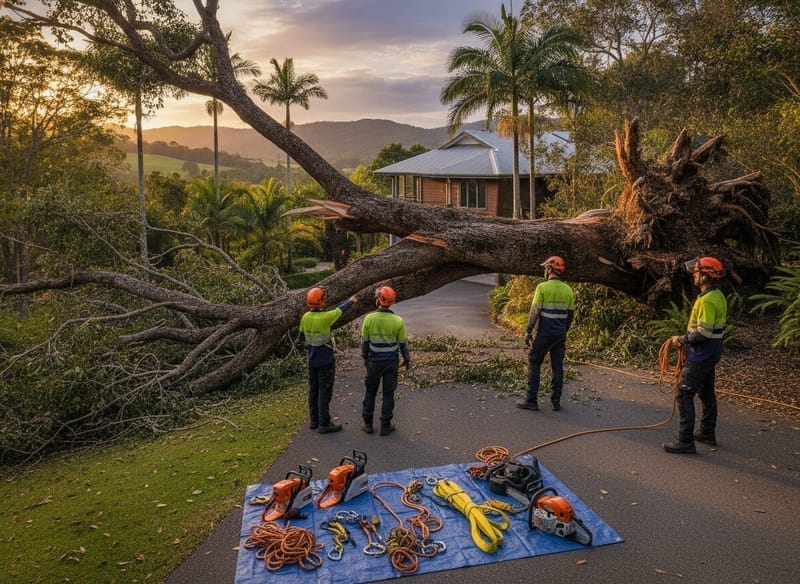
Comprehensive cleanup of shattered canopies, uprooted trees, and storm debris across Fannie Bay.
Restoring storm-damaged properties in Fannie Bay, Parap, Ludmilla, and East Point.
Severe monsoonal squalls and cyclones leave Fannie Bay gardens scattered with broken limbs, split trunks, and uprooted trees. Our storm damage tree removal service handles complete post-event clearing and property rehabilitation.
During wet-season storm events, Fannie Bay's saturated soils reduce root friction. Species like African Mahogany and Weeping Figs frequently suffer complete windthrow, requiring methodical de-limbing to clear safely.
Quickly return your garden, driveway, and outdoor living areas to a tidy, usable condition.
Remove hanging branches and unstable trunks before subsequent squalls push them into your house.
Determine which damaged trees can be saved with restorative pruning and which need removal.
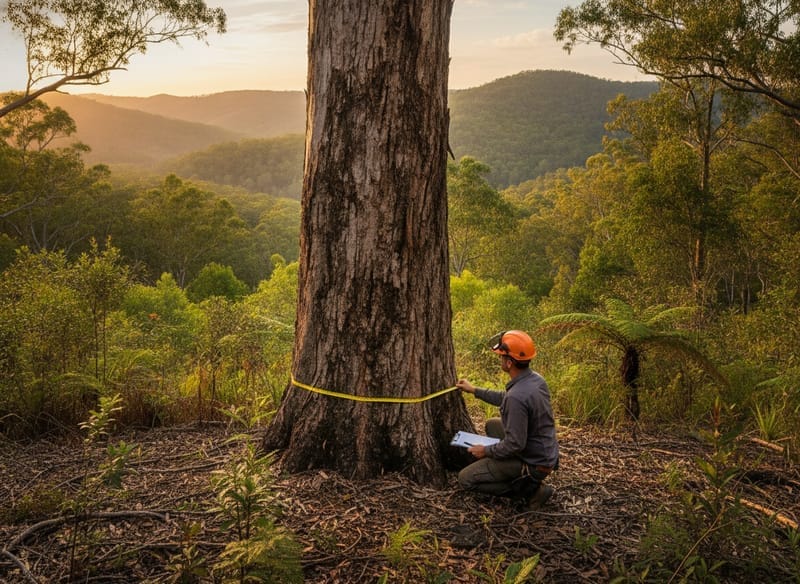
We inspect all trees across your property to identify critical hazards and structural splits.
We start with trees impacting structures and access before moving to general garden debris.
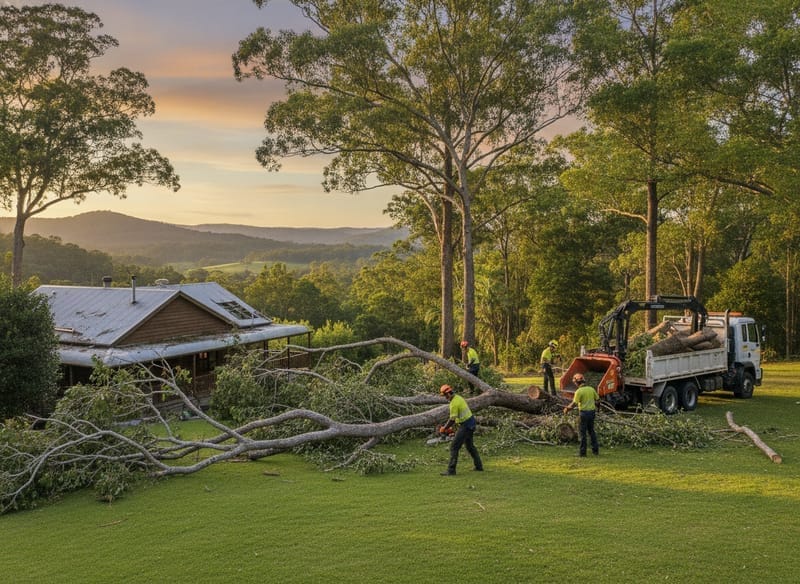
Our team cuts up fallen timber, feeds foliage into industrial chippers, and loads heavy logs.
We clear remaining twigs, rake grounds, and leave your property safe, clean, and secure.
When severe weather strikes the Top End, the aftermath can be overwhelming. For property owners dealing with fallen timber, hung-up branches, or compromised canopies, prompt Storm Damage Tree Removal Fannie Bay is essential to restore safety and access. We are Darwin Arborist, a dedicated local team of climbers and machinery operators who understand exactly how our wet season and monsoonal squalls impact urban vegetation. Our recent history with Severe Tropical Cyclone Fina in November 2025—the earliest landfall on record for the Territory—and the lingering structural impacts of Cyclone Marcus in 2018, have taught us that our local environment demands a rapid, highly skilled response. When saturated lateritic soils combine with gale-force winds, trees with shallow root plates or balled root systems are highly susceptible to windthrow and catastrophic failure. Whether a massive Darwin Stringybark has grazed your roofline or a Banyan tree has shed major limbs across your driveway, our team is equipped to handle it safely. We provide rapid triage and comprehensive clearing, ensuring your property is secure and your insurance claims are supported with accurate arboricultural documentation.
Following a severe monsoonal squall or cyclone, the immediate instinct for many homeowners is to fire up a chainsaw and start clearing the debris. However, tackling storm cleanup without the right qualifications is incredibly dangerous. Uprooted root plates, heavily tensioned timber, and suspended "widow-maker" branches hold immense stored energy. One incorrect cut can cause a trunk to snap back or roll unpredictably, leading to severe injury or further property damage. Furthermore, under-qualified operators often respond to storm-damaged, standing trees by "topping" or "lopping" them in a panic. The Australian Standard for the Pruning of Amenity Trees (AS4373) explicitly discourages these practices. Lopping removes the tree's natural defense mechanisms, promotes weak and rapid epicormic regrowth, and introduces extensive decay. This effectively turns a moderately damaged tree into a ticking time bomb for the next wet season. Our solution prioritises safety, structural integrity, and industry standards. As qualified arborists, our climbers use advanced rope-access techniques and heavy machinery to dismantle hazards methodically. We assess whether a damaged tree can be retained through targeted crown reduction and formative pruning, or if complete removal is the only viable option. By engaging our experienced team, you ensure the hazard is eliminated without creating new risks for your property's future.
Responding to cyclone and storm damage requires more than just heavy machinery; it requires technical expertise and strategic planning. We utilise a range of advanced arboricultural methods to secure and remove compromised vegetation across the Top End.
We prioritize hazards by walking the site, identifying trees threatening structures or powerlines, and securing hung-up limbs before tackling ground debris. This immediate mitigation prevents secondary damage to your property while the broader cleanup is organised.
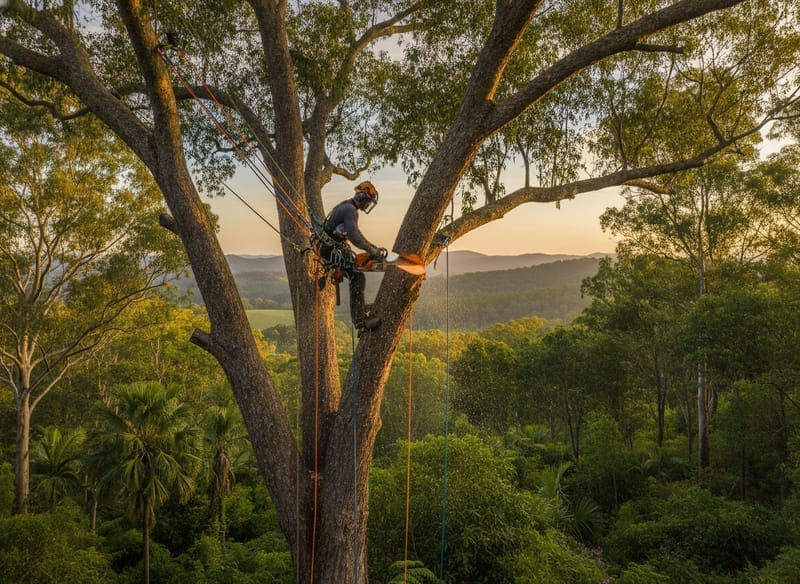
For backyards and tight access areas where elevating work platforms (EWPs) cannot reach, our climbers use double-rope techniques to safely section down damaged timber. We rig branches to lower them in a controlled manner, protecting the landscaping and infrastructure below.
When massive trees collapse onto rooftops or critical infrastructure, we coordinate with local crane operators to hoist heavy tonnages vertically. This eliminates the need to drag heavy timber across delicate roof trusses, vastly reducing the risk of further structural damage.
Fallen trees and uprooted plates are often under extreme mechanical stress. Our chainsaw operators utilize specialized cuts to release the stored energy in spring-poles and wind-thrown root systems, ensuring the timber can be processed safely on the ground without unpredictable kicks.
We efficiently process vast amounts of green waste using high-capacity wood chippers (up to 12-inch) and skid steers. The resulting mulch can be left on site or hauled away in our tipper trucks, alongside heavy log extraction via loader cranes.
When you contact us for Storm Damage Tree Removal Fannie Bay, we follow a highly systematic process to secure your site quickly and transparently, taking the stress out of emergency situations. - Rapid Site Assessment: We arrive promptly to evaluate the structural damage. We identify immediate hazards, such as trunks resting on load-bearing walls or fractured canopies over access routes, and flag them for priority. - Make-Safe Operations: Before dealing with the mess on the ground, we neutralize the immediate aerial threats. Our EWP operators and climbers remove hanging limbs and stabilize split trunks to make the immediate drop-zone safe. - Detailed Insurance Quoting: We provide a comprehensive, itemised quote breaking down the cost of each tree and job line. We capture photo evidence before any cuts are made, formatting our reports so you can submit them directly to your insurance provider to expedite your claim. - Dismantling and Removal: Using top-handle climbing saws, heavy ground saws like the MS500i, and friction-control rigging, we carefully dismantle the hazard. We specialize in controlled drops that protect your retained assets. - Site Cleanup and Stump Processing: Once the hazard is on the ground, we process the canopy through our chippers, haul away the heavy logs, and can optionally grind out the raised stump to 300mm below grade, leaving your property safe and ready for repair.
Safety and compliance are non-negotiable during chaotic post-storm environments. Our crews are led by AQF Level 3 certified climbing arborists who operate strictly under the AS4373 standard for pruning and tree care. We are fully public liability insured and carry comprehensive WorkCover for our entire team, giving you complete peace of mind when we step onto your site.
While AS4970 (Protection of Trees on Development Sites) is rarely a regulatory requirement for emergency residential work, our team actively applies its principles to protect your remaining healthy trees from heavy machinery compaction during the cleanup. If your insurer requires formal risk documentation, we can supply detailed hazard assessments authored by an AQF Level 5 consulting arborist to support your claims and ensure total compliance.
Providing effective Storm Damage Tree Removal Fannie Bay requires a deep understanding of Darwin's unique soils, weather extremes, and council frameworks. During the wet season (November to April), our saturated lateritic red soils and the underlying hardpan severely restrict rooting depth. When cyclones hit, trees with balled root systems—particularly the fast-growing African Mahoganies planted in haste after Cyclone Tracy—are notorious for catastrophic root-plate failures. Fortunately, the regulatory landscape in the City of Darwin is pragmatic for homeowners. There is no private land tree permit or significant tree register governing a standard suburban block, meaning we can respond to hazardous trees on your property without waiting for a council DA. City of Darwin By-Laws protect vegetation strictly on public land and verges. Additionally, while some rural Territory fringes must consider AS3959 bushfire overlays, Fannie Bay tree work is fundamentally driven by cyclone preparedness and wet-season recovery. Whether we are clearing a fallen Sea Almond or a splintered Rain Tree, our local knowledge ensures the job is done swiftly and compliantly.
After a major storm event and the initial cleanup, it is vital to monitor the trees that survived. High monsoonal winds can cause microscopic fractures in trunks and major unions that may not be visible from the ground. Over the following wet season, keep a close eye out for sudden canopy dieback, unusual leaning, or fungal fruiting bodies at the base of your trees. We highly recommend scheduling a follow-up assessment with our AQF Level 5 consulting arborist six to twelve months after severe cyclonic weather. We can perform selective pruning, remove newly formed deadwood, and address any stress-induced epicormic growth, ensuring your remaining canopy is robust, healthy, and resilient before the next cyclone season arrives.
Storm damage cleanup pricing in Fannie Bay depends on the volume of fallen timber, structural entanglement, and site access.
We assess the damage on site and provide a clear written quote before beginning cleanup.
We carry out storm damage tree removal across Fannie Bay and all surrounding Darwin districts.
Contact our experienced local arborists to clean up fallen timber and make your property safe.
Request Storm Cleanup